

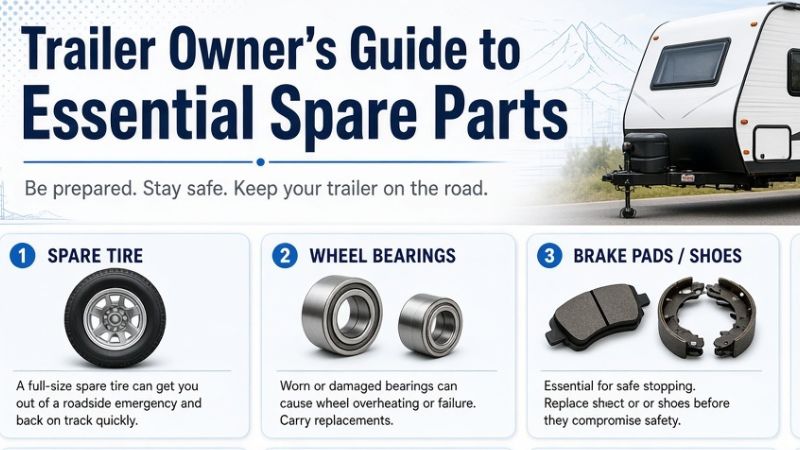
Most trailer failures don’t happen simply because a part is old. They happen because someone fitted the wrong component, chose one with an unsuitable rating, or didn’t realise a failing part was already warning them through vibration, noise, or a slight pull to one side. First-time owners who learn what commonly breaks, and keep the right spares on hand, can avoid the two things most likely to ruin a trip: a roadside breakdown or a defect notice on the side of the highway.
This guide covers what fails, why it fails, what the warning signs look like, and what you should have packed in a box before you ever hitch up.
Table of Contents
Start with the compliance plate, not the parts catalogue
Before buying a single spare, find your trailer’s compliance plate. It’s usually riveted near the drawbar or on the chassis rail and lists the ATM (Aggregate Trailer Mass), GTM (Gross Trailer Mass), and tow ball mass. Write these numbers down, take a clear photo, and keep the details in your phone so you can check them whenever you’re buying parts.
Every part you buy from here on, including bearings, springs, tyres, and brakes, has to be rated to match those figures. This is more than a formality. Overloading the ATM is the root cause of most bearing failures, spring cracks, and tyre blowouts on trailers. A trailer rated to 1,400 kg but running at 1,700 kg will chew through bearings and springs far faster than the same trailer run within spec, and no amount of quality replacement parts will fix the underlying problem. Get the rating right first. Everything else follows from it, including the parts you carry and how much load you can safely tow.
Wheel bearings will fail before almost anything else
If there’s one component responsible for more roadside call-outs than any other, it’s the wheel bearing. Bearings run hot, carry the full weight of the trailer, and are often neglected because they’re hidden inside the hub and give owners little reason to think about them while everything is working.
A full bearing kit, with inner and outer bearings, races, and a seal, should be part of every first-time owner’s toolkit, along with a tub of high-melting-point grease. Bearings need repacking roughly every 12 months or 10,000 km, and sooner if you’ve taken the trailer through water or along dirt roads. Pull the hub, check for pitting, brinelling (small dents from standing load), or discolouration caused by heat, and repack the bearings by hand if everything still looks sound. If the races show wear, replace the whole kit rather than mixing old and new components, since mismatched bearings wear unevenly and tend to fail faster.
Ignore a worn bearing and it won’t fail quietly. It can seize, overheat, and score or snap the axle stub, turning a $40 fix that could have been handled at home into a $400 repair at the worst possible time.
The coupler and chains are the only thing holding the trailer to your car
The 50mm ball coupler is standard on light trailers, and its latch mechanism is the single point of failure between your car and everything being towed behind it. Check the latch for play, confirm that it drops fully over the notch, and make sure the locking pin or clip is present, secure, and not rusted solid. A stretched or worn coupler can pop loose on a rough road, which is not a scenario any owner wants to experience firsthand.
Safety chains are a legal requirement, not a suggestion. They need to be rated for the trailer’s ATM, crossed underneath the coupler when connected, and replaced as soon as a link shows deformation, stretching, or heavy corrosion. A chain that is “probably fine” should not be the only thing deciding whether your trailer stays attached during an emergency stop or after a coupler failure.
Suspension wears out quietly until it doesn’t
Leaf springs, U-bolts, shackles, and shackle bushes take a beating every time the trailer is loaded, and they rarely announce their deterioration loudly. Sagging springs, uneven tyre wear, and a trailer that sways more than it used to are all signs that the suspension is wearing out and needs attention before another trip.
Shackle bushes and pins are worth checking every few months, especially if the trailer sees regular use or rough roads. Once play develops in these components, the trailer starts to hunt from side to side at speed, and the movement gets worse the longer the worn parts are left in place. Springs themselves crack under repeated overload, which is another reason the ATM figure matters so much when loading the trailer.
If you’re heading somewhere remote, carry spare U-bolts and shackle pins. They’re small, light, inexpensive, and easy to store, while a snapped U-bolt on a dirt track with no phone signal is exactly the kind of problem you want to have prepared for at home. This is also where it pays to source exact-match, correctly rated components instead of gambling on generic “universal fit” parts, as a specialist supplier of trailer parts sunshine coast owners actually use will have springs, bushes, and bearing kits matched to your axle rating rather than something that is merely close enough.
Lights and wiring: small parts, big consequences
Water and vibration are relentless on trailer electrics. Corrosion inside a 7-pin flat or 5-pin flat plug is the single biggest cause of light failure, and the fault is often intermittent, working properly in the driveway before dropping out once the trailer is moving on the highway.
Carry a spare plug and a short length of wiring harness so a damaged or corroded connection can be dealt with when it appears. Swap sealed LED combination tail lights in for old incandescent units if you haven’t already, because they resist moisture and vibration far better and are inexpensive enough to keep as a spare pair in the kit. A light-out defect is one of the easiest ways to get pulled over, yet it can be a five-minute fix when you have the correct replacement part and a set of crimpers available.
Brakes are not optional once you’re over the weight threshold
Heavier trailers need electric brakes, and the exact weight threshold varies by state, so check the rules that apply where you live and tow. Trailers over 2 tonnes ATM require a working breakaway brake system as standard, meaning a setup that applies the brakes if the trailer separates from the tow vehicle. The breakaway battery needs to stay charged and the switch should be tested before every trip, rather than waiting until something feels wrong while you’re already on the road.
Inside the brake assembly, magnets wear down and pads glaze over time, both of which reduce stopping power without providing an obvious warning until you’re braking hard. If your trailer has electric brakes, become familiar with adjusting them and learn when magnets and pads need replacing instead of repeatedly tightening components that have already reached the end of their serviceable life.
The brake controller in your tow vehicle also needs to be calibrated for the loaded trailer. A controller configured for an empty trailer will underbrake it once the load is added, which can show up as skidding or as the tow vehicle doing more braking work than it should during a hard stop.
Tyres: the part everyone forgets to check properly
Trailer tyres are different from car tyres in several important ways. Many are speed-rated to 120 km/h only, and running them faster, or using the wrong load index for the axle rating, is a common cause of blowouts. Check the sidewalls for cracking, particularly if the trailer sits unused for long stretches, since UV damage weakens the rubber even when the tread still appears to have plenty of life.
Pressures should be checked cold, and the spare should be fully inflated and mounted on a correctly rated rim rather than any rim that happens to fit the studs. A mismatched rim can flex under load in ways that may not be obvious during a visual check, only becoming apparent when the rim or tyre fails on the road.
Load restraint is a legal requirement, not a preference
Under the National Transport Commission’s Load Restraint Guide, loads on trailers must be secured to withstand 0.8g forward deceleration, 0.5g sideways acceleration, and 0.2g rearward acceleration. In plain terms, a 1,000 kg load exerts roughly 800 kg of forward force during hard braking. That’s a substantial force, which is why rated tie-down points and ratchet straps with a clearly marked Working Load Limit matter as much as any mechanical component fitted to the trailer.
Cheap straps with no WLL rating, along with tie-down points that were never rated to restrain a load in the first place, are a liability. Carry backups in the trailer rather than relying on a single set. Straps fray and buckles bend, usually when they are under pressure and needed most.
The part everyone underestimates: the jockey wheel
The jockey wheel copes with more day-to-day abuse than almost anything else fitted to the trailer. Kerb strikes bend the leg, threads rust and strip, and the wheel itself can crack after repeated contact with rough or uneven ground. None of this seems dramatic at first, but a jockey wheel that won’t wind up or down makes solo hitching close to impossible and can leave the trailer stuck in place.
If you hitch and unhitch often, a spare jockey wheel assembly is worth carrying in the trailer or keeping close at hand. It’s not a glamorous purchase, but it is the part most likely to fail through ordinary use rather than obvious neglect, and replacement is much easier when the correct assembly is already available.
Building your own kit
Once you know what commonly fails, the practical next step is simple: build a dedicated spare-parts box and leave it in the trailer permanently. A sensible kit includes a bearing kit and grease, spare LED lights and a wiring plug, fuses, spring bushes and U-bolts, a couple of extra shackle pins, plus a bottle jack rated for the trailer’s weight. Never rely on a car’s scissor jack, which isn’t built for the trailer’s load or lifting geometry.
A kit like this costs a fraction of one tow-truck call-out or one defect notice. More importantly, it turns the trailer from a mystery box of future problems into equipment you understand and can repair yourself, potentially on the side of the road in ten minutes rather than waiting two hours for help.
That’s the real difference between owning a trailer and simply towing one.